On this page7 sections
A clear place to start
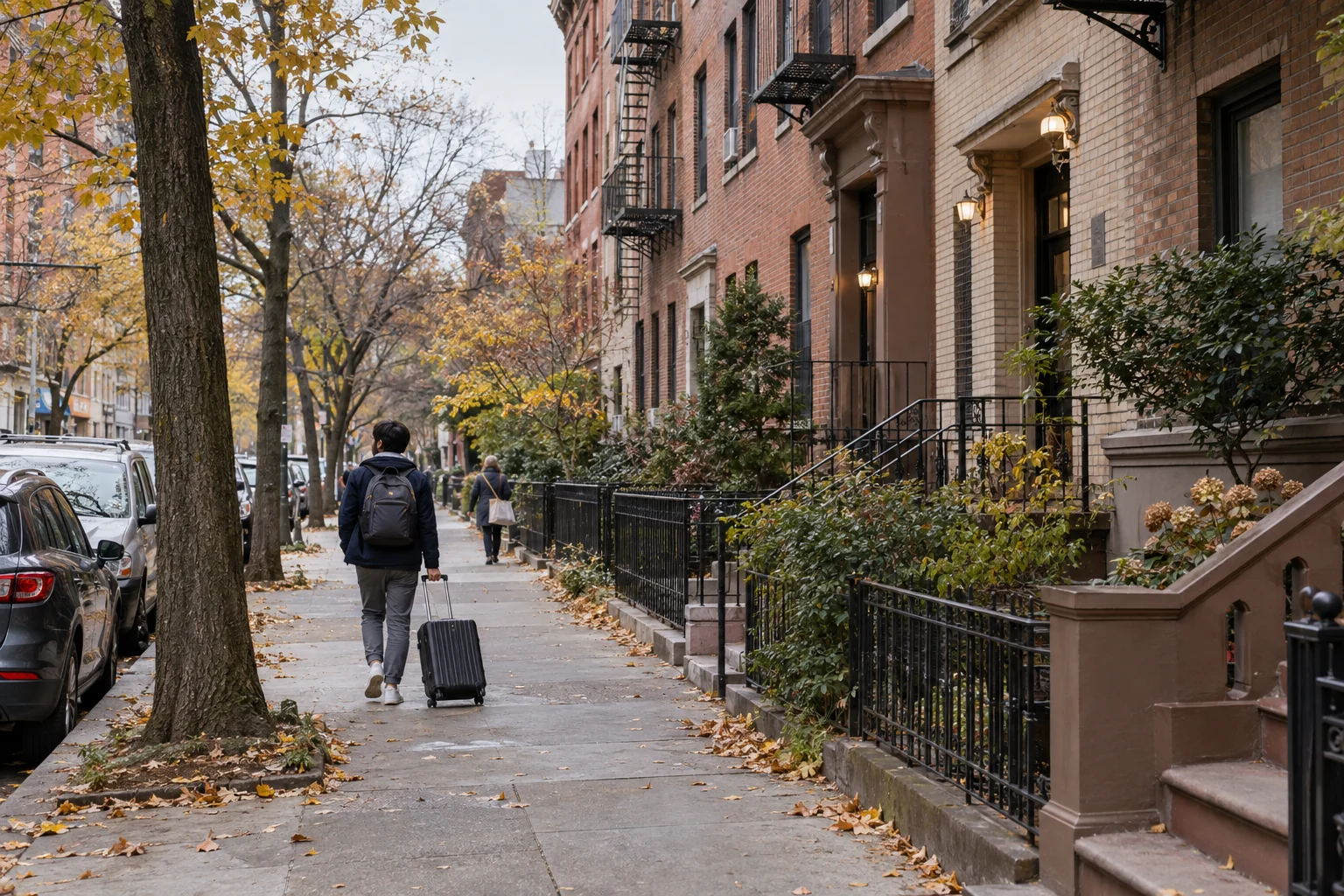
Imagine you have just arrived in New York. Two suitcases, one backpack, and your phone battery at 18%.
(All the scenes below are hypothetical examples, not anyone's personal experience.)
Someone in the group chat tells you to get a phone plan right away. Someone else says to open a bank account first. Another person is already sending you apartment listings. Everything sounds urgent.
But right now, you may only want to know three things: how to get to where you are staying tonight, where nearby you can get a hot meal, and where to go first tomorrow.
So take them in that order. Tonight, focus on your accommodation. In the first three days, sort out your phone, documents, and transportation. Leave money and health care for the remaining days. At the end of the week, write a few lines for the week ahead.
Tonight: Who Has the Keys?
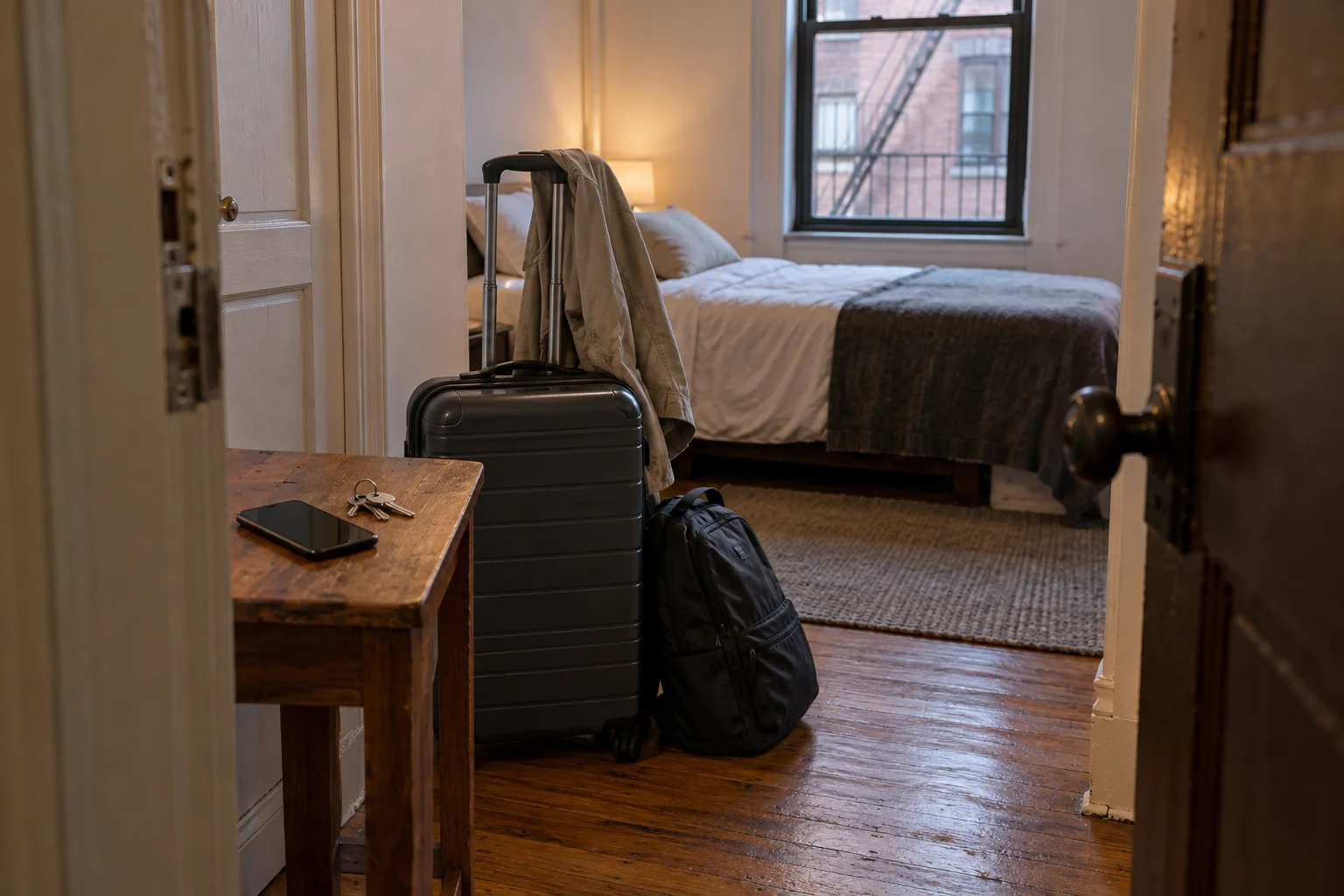
Before leaving the airport, save the full address, building number, room number, and contact person's phone number on your phone, then take a screenshot. When you have no signal, a screenshot is more reliable than any app.
If you are arriving at night, send the person meeting you a message in advance.
I expect to arrive around ten tonight. How do I get the keys when I arrive? If my flight is delayed, what number should I call to reach you?
It seems like an ordinary question. But if you find yourself downstairs with a locked door and no one answering the phone, you will understand how much trouble asking ahead can save.
When planning the trip from the airport, factor in both your luggage and your energy. If you are on your own with two large suitcases, look beyond the price: how many transfers are there, how far will you need to walk, and are there stairs? Trying to find your way through the crowds in Times Square while dragging suitcases sounds exhausting before you even begin. If you are traveling with older adults or children, allow more time, or simply get a car.
Once you arrive, ask someone to show you the locks, hot water, heating, internet, and laundry facilities, then ask where the nearest supermarket is. Get some water and breakfast supplies, have a meal, and get some sleep. Everything else can wait until tomorrow.
If you arrive in October or later, check the radiator while you are there. New York's heating season starts on October 1. If your place feels unusually cold, the article about heating in this series explains whom to contact.
Once Your Phone Works, a Lot Else Gets Easier
Directions, contacting your landlord, making appointments: you need it for all of them.
Before going to a phone store, find out whether your phone is locked to your previous carrier and whether it can use U.S. carriers' networks and SIM cards. If you are unsure, ask a store employee to check the model and compatibility.
Then be specific about what you need.
I am bringing my own phone and would like a plan with a U.S. number, calls, text messages, and data. What is the total I would pay today? How much would it cost each month after that? Is there an activation fee? How do I cancel?
When the employee describes a promotion, ask one more question.
Does this price require automatic payments? How much will it cost after the promotion ends?
Ask them to write down the plan name and charges, or show them to you on the order page. Once it is set up, turn off Wi-Fi while you are still in the store and open a webpage using mobile data. Then test calls and incoming texts. Save your new number so you will not have to dig through the packaging when a form asks for it a few days later.
If your number back in China is still linked to your bank and WeChat, remember to ask how to keep it active and what roaming costs.
There is something else that may happen sooner than you expect. Quite a few people on Xiaohongshu have written about receiving calls from someone claiming to be from the 「consulate」 or the 「police」 just days after arriving in the United States. If an unfamiliar caller says you are involved in a criminal case, tells you to keep it secret, and asks you to transfer money, hang up. The article in this series about callers impersonating the police and consulates breaks down this script.
Find a Quiet Moment to Organize Your Documents and Dates
After you have rested on the first day, half an hour is enough.
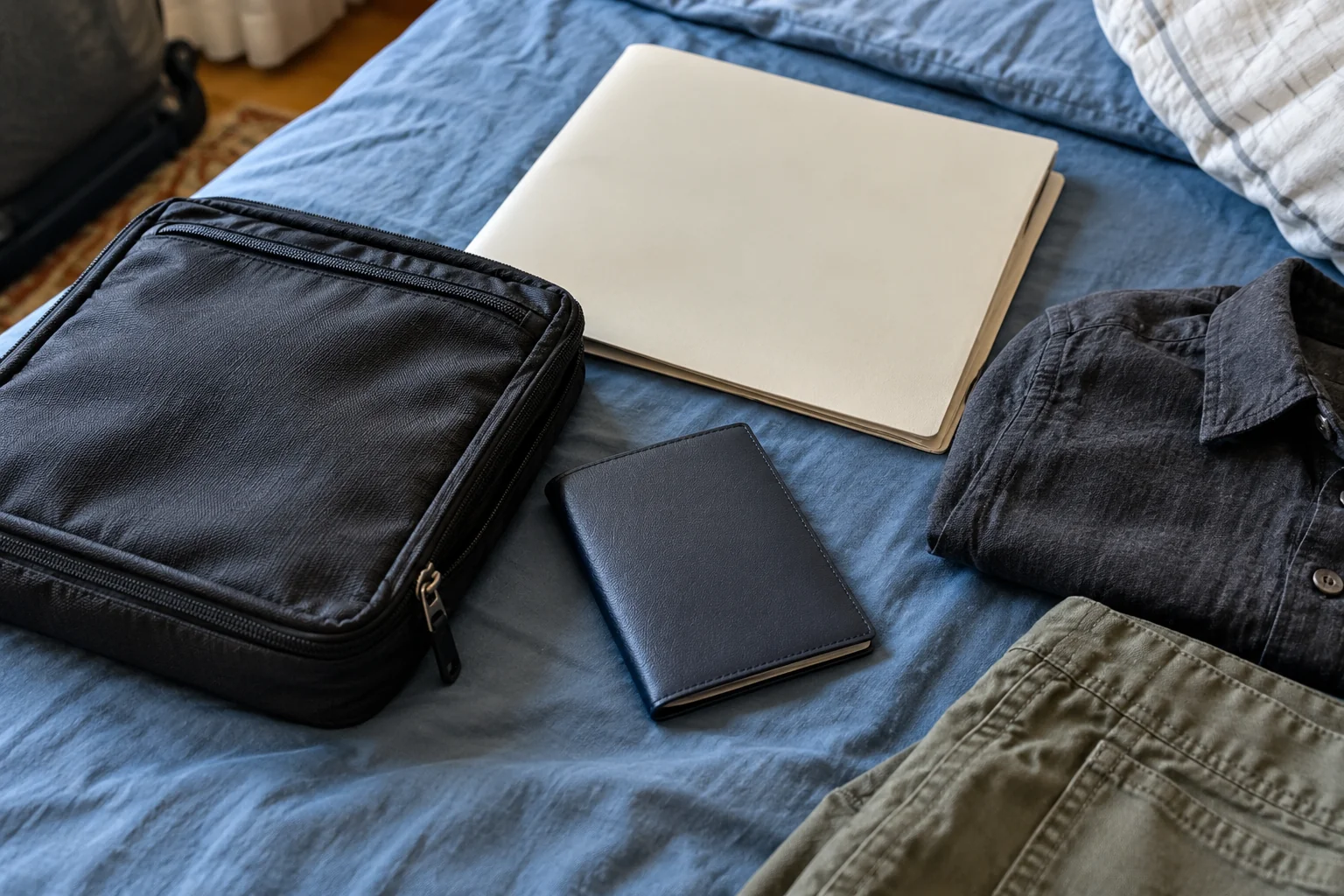
Create a folder on your phone or computer that only you can access. Organize the documents and materials relevant to you by name, such as 「Passport」, 「Arrival Record」, 「School Documents」, and 「Appointment Confirmation」. Keep the originals somewhere safe separately.
If an I-94 arrival record applies to your situation, you can look it up, download it, and check it through the official CBP portal. If there is anything you do not understand, ask the relevant organization or a qualified professional. Do not guess.
Then go through the emails from your school or employer and pick out anything with a deadline: checking in, appointments, submitting documents. If you are here to study, you can ask your school's international student office directly.
I have arrived in New York. What check-in steps do I need to complete next, and by when? Do I need to come in person, or can I do them online?
Put the dates you receive straight into your phone calendar, with a reminder one day ahead.
Friends' experiences can be useful, but when it is your turn to handle something, make sure you get answers to three questions: Do I need to do this in my situation? When should I do it? What should I bring? Everyone's status and procedures are different. Someone else's 「must-do」 may not apply to you.
Your First Subway Trip: Check the Route There and Back
Choose a daytime when you are not in a rush, and try a route you expect to use regularly.
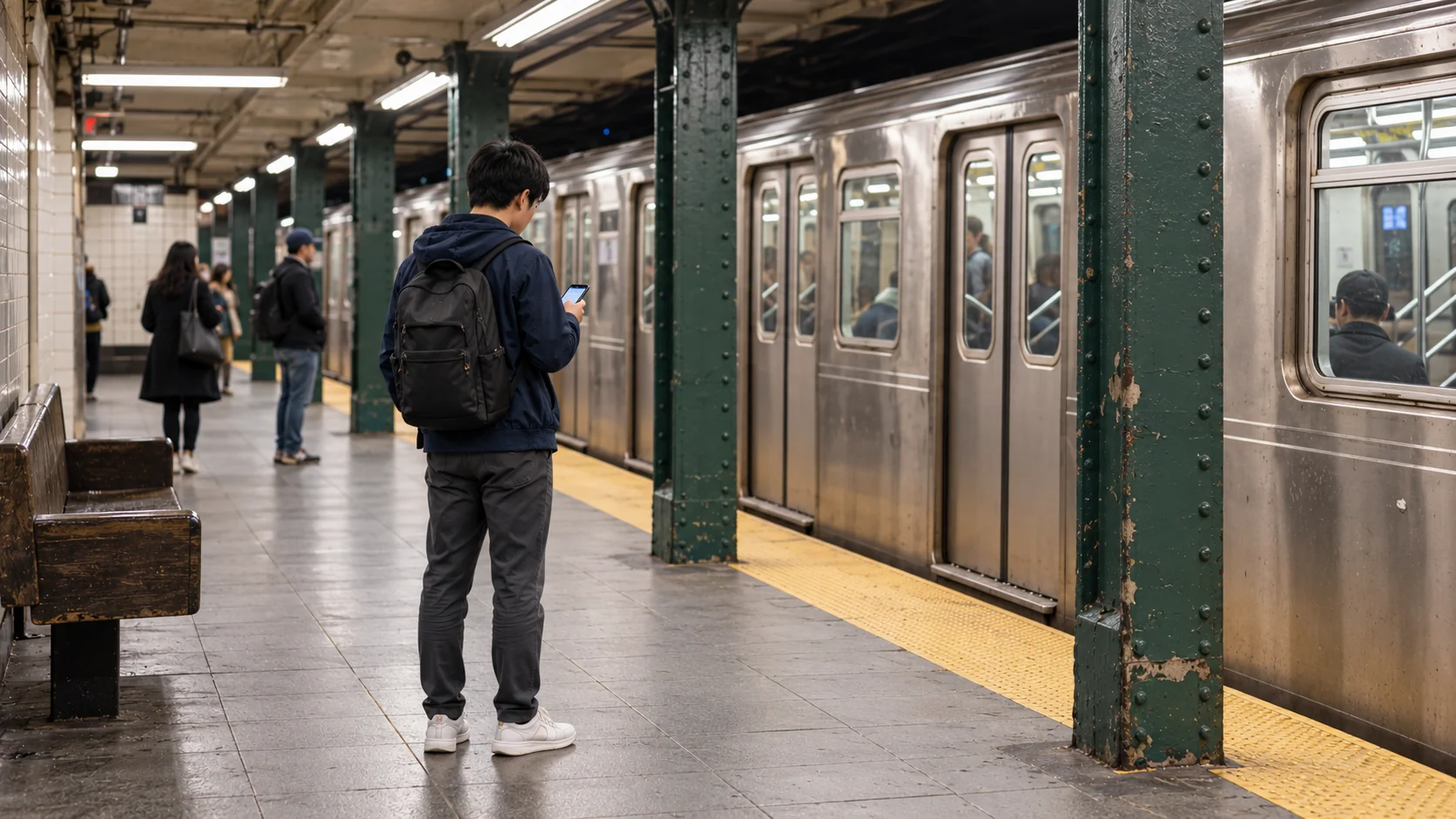
For example, say you are staying in Flushing and want to see Times Square. During normal service, take the 7 train toward 34 St-Hudson Yards and get off at Times Sq-42 St. On the way back, look for the 7 train toward Flushing-Main St. Before leaving, check for any temporary service changes that day (MTA 7 train schedule).
Note three things on your phone: where to board, which direction to take, and where to get off. Once you are in the station, check the signs again. In Manhattan, Uptown generally means north and Downtown means south. Check the route number and the train's final destination too (MTA subway guide).
If you cannot make sense of it, show a staff member your destination.
Does this train stop here?
You do not have to buy a separate card to pay. Tap a contactless bank card, mobile wallet, or OMNY card on the turnstile reader. When you see GO, you can enter. A single subway or local bus ride costs $3 (MTA fares page).
Here is a useful detail many newcomers do not know. OMNY has a seven-day fare cap. Keep using the same card, or the same card on the same phone. Starting with your first tap, once you have paid $35 for subway and local bus rides within seven days, the remaining rides in that seven-day period will not cost any more (OMNY rules). If you switch what you tap with, the payments will not count together.
On the way home, look for supermarkets, pharmacies, and laundromats near where you are staying, and save them on your map. You will not have to search all over again every time you need groceries or laundry.
Before Going to the Bank, Make a Call
If you want to open a bank account, call or message the branch you plan to visit. Find out which documents you need, then make an appointment.
For example, if you are temporarily staying with a friend and do not yet have a utility bill in your own name, you can say so directly.
I have just arrived in New York and am staying with a friend temporarily. I would like to open a personal account. What forms of identification and proof of address do you accept? These are the documents I have right now. What else do I need? Do I need an appointment?
If an SSN or another tax identification number comes up, explain your actual situation and let them tell you the requirements. Different banks and different accounts may require different things. Take notes, and if possible, ask them to send you an official document checklist.
Even if you can open the account, ask whether it suits your needs.
Does this account have a monthly fee? What are the conditions for waiving it? I will not have payroll deposits for now. How much would I be charged?
Once the account is open, ask how to log in to mobile banking, where the card will be mailed, roughly how many days it will take, and what number to call if something goes wrong. Getting these answers now will make dealing with statements much easier later.
If You Feel Unwell, At Least Know Whom to Contact First
Do a little preparation while you are still feeling well.
If you have insurance, save a photo of your insurance card and your insurer's customer service number. When you need a doctor, call the insurer or clinic first. Tell them exactly which plan you have, and ask whether the clinic is in-network, whether it accepts new patients, and how to make an appointment. If you take medication regularly, ask early.
I have just moved to New York and need to continue taking this medication. What should I bring to my first appointment? What is the earliest available appointment?
Organize the medication names, prescriptions, and previous medical records in advance so the doctor can assess them.
If you do not yet have insurance, you can learn about NYC Care, a program from New York City's public hospital system. It is not health insurance. Whether you qualify and how much you would pay must be assessed. NYC Care and insurance open enrollment are separate things. The state's insurance marketplace begins open enrollment for 2027 coverage on November 1. The article about health insurance in this series goes into more detail.
Save two more numbers on your phone. If you need police, firefighters, or emergency medical help to come immediately, call 911. For non-emergency New York City government services, call 311. When you call 311, you will first hear instructions in English. Language options come after about ten seconds: press 5 for Mandarin or 6 for Cantonese. You can also speak Chinese through an interpreter when you call 911. If you are not comfortable with English, one sentence will do.
Mandarin interpreter, please.
For Cantonese, say Cantonese. Both numbers provide Chinese-language service through interpreters (New York City information).

On Day Seven, Write a Few Lines for Next Week
At the end of your first week, open your phone's notes and see what is still unfinished.
Write a specific action next to each item. That is much more useful than a heading alone.
「Open a bank account」 can become: Call the bank on Monday and ask what documents I can use for the address where I am staying with a friend. Make an appointment once I have everything.
「Find an apartment」 can become: Arrange to view two places within my budget and try the trip from each one to school or work. Do not transfer money before seeing the place and signing an agreement. Ask for every charge in writing.
「Find a job」 can become: First, clarify the work eligibility rules that apply to me, then update my résumé. When a job post catches my eye, read the article about job listings in this series first.
When you have just arrived somewhere new, grocery shopping, getting around, and even answering a phone call all take a little longer than usual. Give yourself some room.
Once you know which supermarket near home you like, can get around on your own to run errands, and know whom to ask when something comes up, life will gradually get easier.
New York is huge. But your New York starts within a kilometer of where you live.
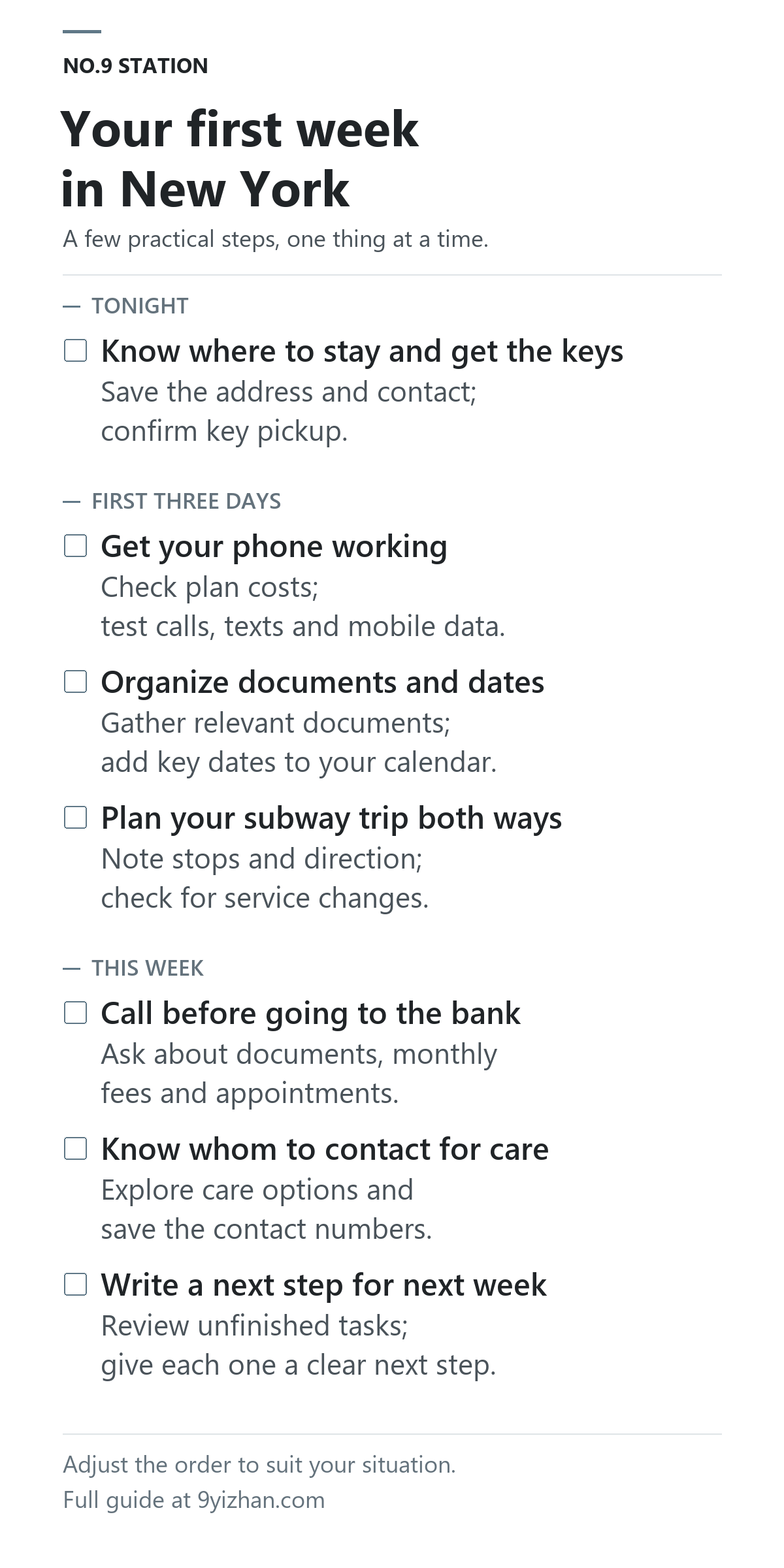
Save your first-week checklist
Seven practical steps from this guide, ready to save and revisit.
Verification Dates and Sources
Subway fares and the OMNY fare-cap rules were checked on October 21, 2026; the rest of the content was checked on October 16. All scenes in this article are hypothetical. Fees, required documents, and service arrangements are subject to the latest information from each organization.
View official sources
U.S. Customs and Border Protection (CBP): Official I-94 portal (https://i94.cbp.dhs.gov/)
MTA: 7 train schedule (https://www.mta.info/schedules/subway/7-train); Subway guide (https://www.mta.info/guides/riding-the-subway); Fares (https://www.mta.info/fares)
OMNY: Fares (seven-day cap) (https://omny.info/fares)
NYC Care: FAQ (https://www.nyccare.nyc/faq/)
NYC311: Multilingual services (https://portal.311.nyc.gov/article/?kanumber=KA-03549)
A useful next step?
JOIN THE CONVERSATIONReader notes
Checking sign-in…
Loading reader notes…