
On this page12 sections
A clear place to start
In a hurry? Start here
If a store has no posted return policy, unused, undamaged goods can be returned within 30 days with proof of purchase. You choose whether to receive cash or credit.
The U.S. Postal Service (USPS) will not text you unless you have signed up, and even texts you have signed up for will not contain links. Do not click these texts; forward them to 7726.
A credit card offers the most protection for online shopping. If your goods never arrive, your dispute letter must reach the card issuer within 60 days of the date the first statement showing that charge was sent. Do not wait until the last few days to mail it.
Suppose Xiao Zheng buys quite a few things on Black Friday.
(Xiao Zheng is fictional, and the scenes below are hypothetical.)
She buys a coat at the mall, then tries it on at home and finds that it does not fit. A vacuum cleaner she ordered online was supposed to arrive in a week. Two weeks later, there is still no sign of it.
That night, a text arrives on her phone: 「USPS: Your package could not be delivered because the address is incomplete. Please click the link to update your address.」 The next day, an Amazon box appears at her door, but she never bought anything like it.
What people are asking in the comments
Over the past six months, people on Xiaohongshu have posted about suddenly receiving piles of packages at home. The address is theirs, but none of the addressees are people they know. They ask what to do. The posts attract plenty of comments: some people have experienced the same thing, some guess it is fake-review activity, and others suspect misuse of an address or credit card fraud. The explanations vary. Other people describe losing money to a text soon after arriving in the United States and warn everyone to be careful.
These are the posters' accounts of their own experiences. Below, we will work through the official explanations from New York State, New York City, the Federal Trade Commission (FTC) and the U.S. Postal Inspection Service (USPIS), one thing at a time.
In-store returns: first check for a posted policy
Section 218-a of New York State's General Business Law (the original text) requires stores to display their return policy prominently, for example on the merchandise, beside the register or at the entrance. Online stores must display the policy, or a link to it, alongside the goods or before you enter payment information.
If a policy is posted, follow it. If none is posted, the Department of State's Division of Consumer Protection said in its December 2025 reminder that the retailer must accept unused, undamaged goods within 30 days of purchase. You need proof of purchase, such as a receipt, and you choose whether the refund is cash or credit. If an online store has not displayed its policy as required, the same 30-day rule applies.
The New York City Department of Consumer and Worker Protection (DCWP) has a few other useful points in its holiday shopping tips. For purchases over 20 dollars, the seller must give you a receipt. For purchases from 5 to 20 dollars, it must give you one if you ask. Charging more at checkout than the posted price is illegal.
I don't see a refund policy posted. It's unused and I have my receipt, so under New York law I can return it within 30 days. I'd like a cash refund, please.
I have not seen a return policy posted in the store. The item is unused and I have the receipt. Under New York State law, I can return it within 30 days. I would like cash back.

Online order running late? The seller must notify you first
The FTC's guidance on mail and online orders says that if a seller promises to ship within a certain time, it must have a reasonable basis for meeting that promise. If it gives no time, it must ship within 30 days. If it cannot ship on time, it must notify you first, ask whether you agree to a delay, and tell you that you can cancel for a full refund. For a first delay with a new shipping date no more than 30 days away, not replying counts as agreement. A longer delay requires your explicit agreement. After cancellation, payments made in cash or by check must be refunded within 7 business days. The same deadline applies to ordinary bank credit card payments.
Notice that this rule concerns 「shipping」. If the item has already shipped and is lost on the way, go to section 7 below on disputing the charge through your credit card.
For Xiao Zheng's vacuum cleaner, she can start by asking whether the seller has shipped it.
My order still hasn't arrived. Has it shipped yet? If you can't ship it by the end of this week, please cancel my order and give me a full refund.
My order has not arrived. Has it shipped? If you cannot ship it this week, please cancel the order and refund me in full.
Gift cards: nine years, with no maintenance fees
Many people receive gift cards toward the end of the year. Section 396-i of New York State's General Business Law (the original text) says that a purchased gift card cannot expire until at least nine years after it was issued or last reloaded, whichever is later. Promotional and reward cards you receive without paying for them, such as a gift with a qualifying purchase or a card redeemed with points, are outside this provision. Gift cards cannot carry activation, redemption, service or inactivity maintenance fees. A general-use gift card accepted at many unrelated stores may charge a single activation fee of no more than 9 dollars. If a card is neither general-use nor promotional, you can ask to exchange a balance of less than 5 dollars for cash.
The Department of State's reminder says the nine-year rules cover gift cards purchased on or after December 10, 2022. The city's holiday shopping tips and Chinese flyer still say 「valid for five years」. That is the old rule; use the state law.

「Your package couldn't be delivered」: don't click the text
The text Xiao Zheng received is one of the most common examples.
The U.S. Postal Inspection Service says USPS sends texts or emails only after you have signed up yourself using a tracking number. Those messages do not contain links. Its advice is straightforward: do not click the link. If you are waiting for a package, go to the USPS website yourself to check the tracking number. If you have already clicked, contact your bank immediately.
There are two ways to report it. Copy the text and email it to spam@uspis.gov, together with your name and a screenshot showing the sender's number and the date. Also forward the text to 7726. The FTC's reminder likewise says to check shipping through the store where you placed the order or through your account.
A package you didn't buy: check the addressee, then change your passwords
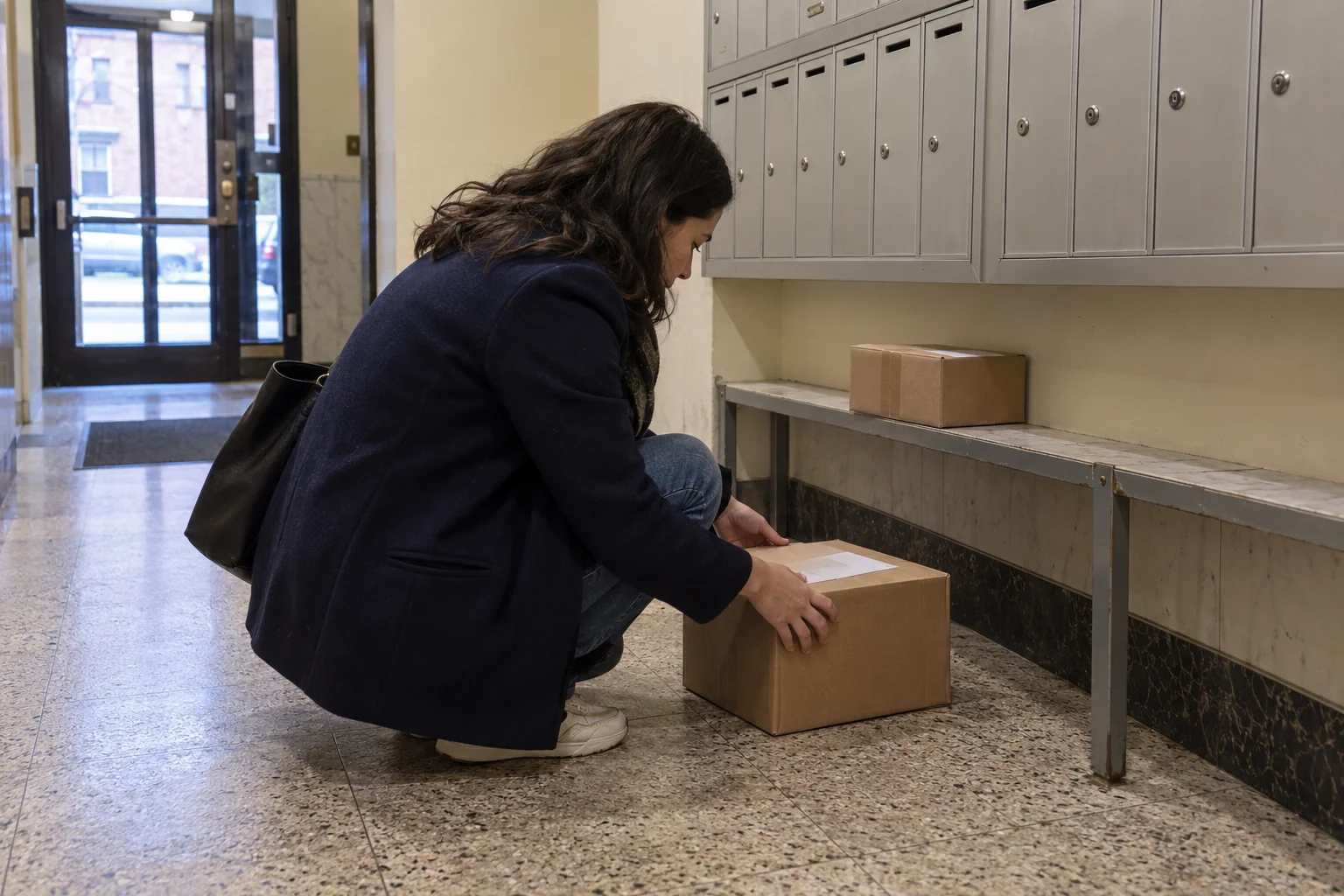
For the Amazon box at the door that Xiao Zheng did not buy, first check whether it is addressed to her, then ask friends and family whether someone sent a gift. If neither explains it, it may well be 「brushing」. If someone else's name is on it, it was misdelivered. Contact the delivery service or shopping platform rather than keeping it as your own.
The FTC's August 2026 reminder says a scammer may have used your name and address to send cheap goods so they can post fake positive reviews in your name. You do not have to return or pay for unordered goods sent to you. But if you do not know who sent them, be careful before using them. If the package includes a QR code claiming you can scan it to find out who sent it or arrange a return, do not scan it. It may lead to a phishing site trying to steal your credit card number.
The FTC recommends a few steps. Change the passwords on your shopping accounts, because they may have been compromised. Check your credit reports for free at AnnualCreditReport.com. Tell the shopping platform selling the item so it can investigate the seller. Then report it at ReportFraud.ftc.gov.
Deeply discounted designer goods on social media: take another look
FTC data published in April 2026 say that reported losses from scams that started on social media reached 2.1 billion dollars in 2025. Shopping scams were the most commonly reported type. Among people who lost money through social media, at least 40% said they had bought something they saw in a social media advertisement.
The FTC's online shopping tips and holiday reminders make a few points. Before ordering, search for the seller's name together with 「complaint」 or 「scam」. Paying by credit card gives you the most protection. A seller who says it accepts only gift cards, wire transfers, transfer apps or cryptocurrency is very likely a scam.
Overcharged or no delivery? Dispute it with your credit card issuer
The FTC's guidance on credit card disputes says that goods not delivered as agreed count as a billing error you can dispute. Your dispute letter must reach the card issuer within 60 days after the first statement containing the incorrect charge was sent. Send it to the 「billing inquiries」 address on the statement, not the payment address. The bank must acknowledge it in writing within 30 days and resolve it within 90 days.
That is another reason a credit card is the better option for online shopping. Debit and credit cards have very different limits on your liability for unauthorized use; the article about credit history in this series covered that. If you pay through 「buy now, pay later」 (BNPL), understand that its protections differ from those of a credit card. The Consumer Financial Protection Bureau issued an interpretive rule in 2024 saying BNPL lenders also had to handle billing disputes under credit card rules. That rule was withdrawn in May 2025 (CFPB guidance).
Where to complain
New York City Department of Consumer and Worker Protection (DCWP): You can complain online, or download a complaint form in Simplified or Traditional Chinese, fill it out and mail it to 42 Broadway, New York, NY 10004, or fax it to 212-487-4482. The city's holiday shopping tips also say you can call 311.
New York State Department of State, Division of Consumer Protection: Its helpline is 1-800-697-1220, Monday through Friday, 8:30 a.m. to 4:30 p.m., except state holidays.
New York State Attorney General's Office: Call 1-800-771-7755 or complain online.
Federal Trade Commission (FTC): Use ReportFraud.ftc.gov, or call 877-382-4357 between 9 a.m. and 5 p.m. Eastern Time and press 3 for language options (FTC Chinese resources).
Two 「buts」
「But the employee says they only exchange items, with no refunds.」
First check whether that is what the store's posted return policy says. If it is posted, follow it. If no policy is posted, the 30-day rule above applies, and you choose cash or credit. If those words appear only on the receipt and could not be seen anywhere in the store before you paid, that does not count as posting the policy. You can ask the employee to point out where it is displayed.
「But the seller says Zelle is faster and comes with a discount.」
A seller offering a discount to persuade you to bypass a credit card is itself a reason to be cautious. The FTC is clear: a seller who accepts only transfer apps, gift cards, wire transfers or cryptocurrency is very likely a scam. With a credit card, you can dispute a charge if something goes wrong. Money sent through a transfer app is hard to recover.
One last thing
Xiao Zheng returned the coat, canceled the vacuum cleaner order and forwarded the text to 7726. As for the Amazon box, she changed her password and notified the platform.
During these weeks when people shop more than at any other time of year, three things are enough to remember: check for a posted policy, pay with a credit card, and do not click links in texts.
What is the most convincing scam text you have received? Share it in the comments, and remember to remove the link.
Three things to do next
- Read the return policy before buying and keep proof of purchase.
- Avoid links in delivery texts; check tracking through the official site or your shopping account.
- Contact the card issuer early about missing goods or incorrect charges and check dispute deadlines.
Date checked and sources
The pages below were checked on November 1, 2026. Xiao Zheng and the scenes are hypothetical. The situations described in 「the comments」 come from public Xiaohongshu posts and are readers' accounts. This article is a general information summary, not legal advice. Refer to the official original text for specific rules.
View official sources
New York State law: General Business Law §218-a, return policies (https://www.nysenate.gov/legislation/laws/GBS/218-A); General Business Law §396-i, gift cards (https://www.nysenate.gov/legislation/laws/GBS/396-I)
New York State Department of State, Division of Consumer Protection: holiday returns reminder (December 24, 2025) (https://dos.ny.gov/news/consumer-alert-new-york-department-states-division-consumer-protection-reminds-holiday); gift card rules reminder (December 9, 2022) (https://dos.ny.gov/news/consumer-alert-nys-division-consumer-protection-alerts-consumers-new-laws-related-gift-cards)
New York City Department of Consumer and Worker Protection (DCWP): holiday shopping tips, updated November 2023 (https://www.nyc.gov/site/dca/consumers/holiday-shopping-tips.page); complaints (https://www.nyc.gov/site/dca/consumers/file-complaint.page)
New York State Attorney General's Office: consumer complaints (https://ag.ny.gov/file-complaint/consumer)
Federal Trade Commission (FTC): mail and online order rule (https://www.ftc.gov/business-guidance/resources/business-guide-ftcs-mail-internet-or-telephone-order-merchandise-rule); USPS text scam reminder (April 23, 2025) (https://consumer.ftc.gov/consumer-alerts/2025/04/think-text-message-usps-it-could-be-scam); brushing package reminder (August 20, 2026) (https://consumer.ftc.gov/consumer-alerts/2026/08/unexpected-package-you-got-could-be-brushing-scam); social media scam data (April 27, 2026) (https://www.ftc.gov/news-events/news/press-releases/2026/04/new-ftc-data-show-people-have-lost-billions-social-media-scams); online shopping tips (https://consumer.ftc.gov/articles/online-shopping); holiday shopping reminder (November 25, 2025) (https://consumer.ftc.gov/consumer-alerts/2025/11/how-avoid-online-shopping-scam-holiday-season); credit card disputes (https://consumer.ftc.gov/articles/using-credit-cards-and-disputing-charges); Simplified Chinese resources (https://consumer.ftc.gov/features/consumer-education-multiple-languages-simplified-chinese)
U.S. Postal Inspection Service (USPIS): package tracking text scams, updated May 19, 2025 (https://www.uspis.gov/news/scam-article/smishing-package-tracking-text-scams)
Consumer Financial Protection Bureau (CFPB): buy now, pay later guidance (https://www.consumerfinance.gov/compliance/compliance-resources/consumer-cards-resources/buy-now-pay-later-bnpl-products/)
A useful next step?
JOIN THE CONVERSATIONReader notes
Checking sign-in…
Loading reader notes…