
On this page9 sections
A clear place to start
In a hurry? Start here
The EOB your insurer sends isn't a bill. A hospital bill shouldn't be higher than the amount the EOB says you owe.
New York hospitals must provide financial assistance based on income. Households with income at or below 400% of the federal poverty level can apply, with no application deadline and regardless of immigration status.
While your application is being reviewed, the hospital can't require payment upfront or send the bill to a collection agency.
Let's say Afang goes to the emergency room with stomach pain in the middle of the night.
(Afang is fictional, and the situations below are hypothetical.)
She has blood drawn, gets a CT scan, stays overnight for observation and goes home the next day. Three weeks later, two letters arrive in her mailbox.
One is from her insurer. At the top, in large letters, it says “THIS IS NOT A BILL,” followed by a string of numbers. The other is from the hospital. At the bottom, it says Amount Due: $4,800. A few days later, another letter arrives, from a physician group she's never heard of. They want $900.
Afang's first instinct is to pull out her credit card and pay online. Better to get it over with before a delay causes trouble.
Hold on.
What people are asking in the comments
Over the past six months, Xiaohongshu has had no shortage of posts about enormous bills: tens of thousands of dollars for an ER visit, thousands for a scan, even over $10,000 for an emergency vet visit. Some people post a bill and ask why a charge of over $600 becomes thirty-something dollars after an insurance adjustment. Where did that original $600-plus figure come from? There are also plenty of posts explaining how much you can “negotiate a bill down,” some of them selling services to do it for you.
These are the posters' accounts of their own experiences. This article isn't judging any particular post. But there is a process you can follow after a bill arrives.
First, work out which documents you have
Afang actually has three different things.
The document from her insurer is an EOB: an Explanation of Benefits. The Centers for Medicare & Medicaid Services (CMS) puts it plainly: an EOB isn't a bill. It tells you what the hospital charged for the visit, how much the insurer allowed, how much it paid, and how much is left for you to pay. CMS also says the hospital's bill shouldn't exceed the amount in the EOB's “you owe” column. If it does, ask the hospital about it.
The document from the hospital is the hospital's own bill. The separate physician group often bills for emergency physicians, radiologists or other doctors separately. Getting more than one bill after a single ER visit isn't unusual.
Then there's the “original price” that confuses so many people. Charge is the hospital's listed price. If you have insurance, the insurer and hospital have a negotiated rate; the difference is subtracted as an Adjustment. The insurer pays part of what's left, and you pay part. So when a charge of over $600 becomes thirty-something dollars, it isn't the hospital suddenly being generous. The negotiated price was much lower to begin with.
Ask for an itemized bill
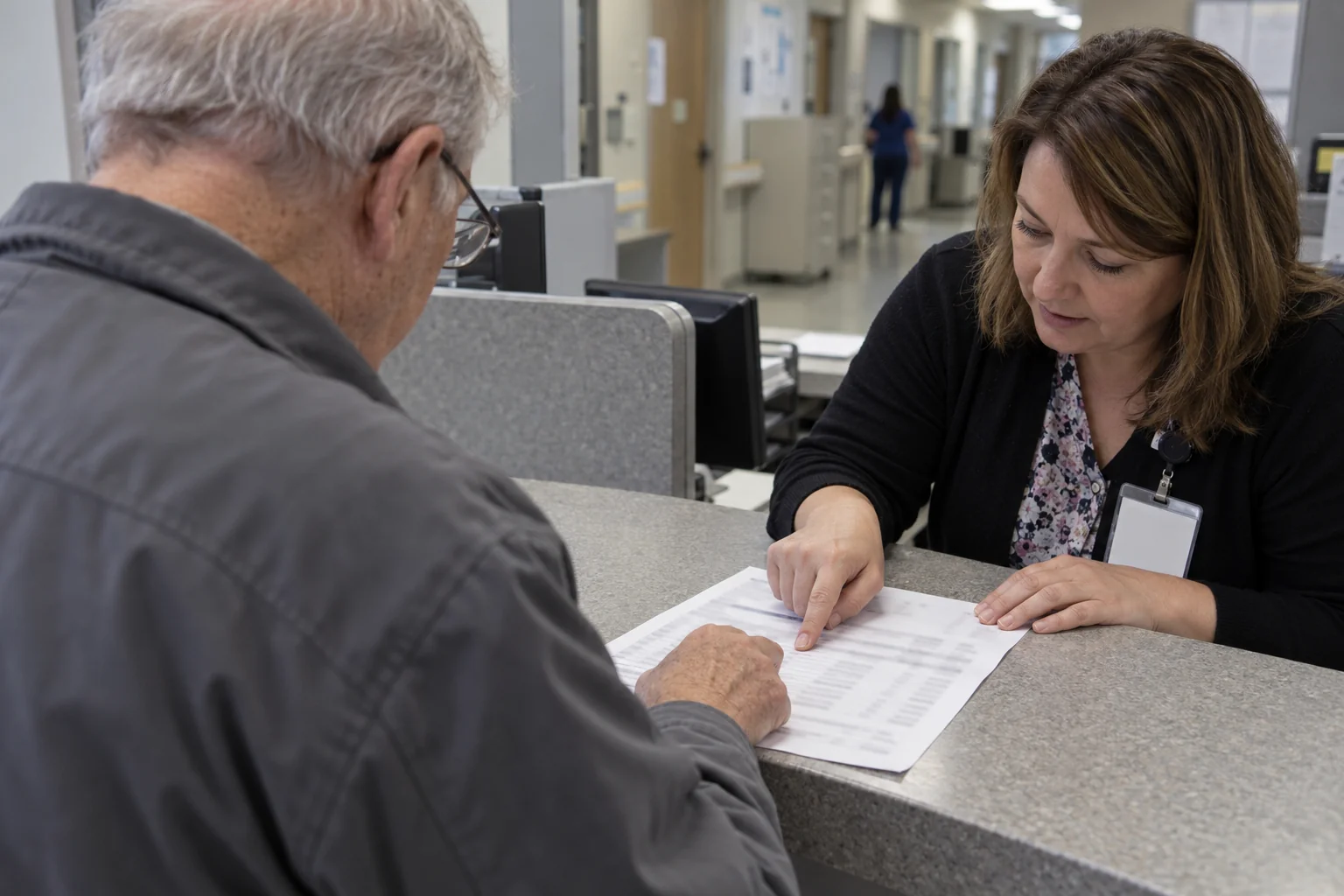
Many bills show only a total. Rather than worrying over that one number, ask for the breakdown first.
New York State's Patients' Bill of Rights says patients have the right to an itemized bill and an explanation of all charges. CMS also recommends requesting the cost of every test and service so you can check each one.
Once you have it, look for these things.
Are the dates right? Is there a charge for a day you weren't there?
Has the same item been charged twice?
Are there tests you never had or medications you never received?
Is the insurance information correct? If the insurance number was entered incorrectly, the insurer may not have paid.
When you call the hospital's Billing Office, you can say this.
Could you send me an itemized bill with the billing code for each charge?
In other words, please send a line-by-line bill, with a billing code for every item.
Have insurance? Check for a surprise bill or a denied claim
That bill from Afang's physician group deserves a closer look.
Under the federal No Surprises Act, when you receive emergency care, your share can't exceed the in-network cost-sharing amount, even if the hospital or doctor is outside your insurance network. You're also protected when you have surgery or tests at an in-network hospital but encounter out-of-network providers for services such as anesthesia, radiology or lab work (CMS guidance). If you have questions, call the CMS No Surprises Help Desk at 1-800-985-3059. Note that the federal rule doesn't cover ground ambulances.
New York State also has surprise billing rules, overseen by the Department of Financial Services (DFS). DFS says you only need to pay the in-network cost-sharing portion of a surprise bill. If an in-network doctor referred you to an out-of-network doctor, you need to sign a Surprise Medical Bill Certification Form and send it to the insurer and that doctor. Whether your insurance falls under state or federal rules depends on the type of plan. If you're unsure, call DFS at (800) 342-3736.
If the insurer denies the claim outright, start with an internal appeal to the insurer. If its final internal decision is still a denial, you can apply to DFS for an external appeal within 4 months. The insurer may charge up to $25 per appeal, capped at $75 a year, and must refund the fee if you win. The fee can be waived for people receiving Medicaid or Child Health Plus, or those experiencing financial hardship. The DFS external appeal number is (800) 400-8882, and the forms are available in Chinese.
Is this provider in my network? If not, is this bill protected under the No Surprises Act or New York's surprise bill law?
In other words, is this doctor covered by my network, and if not, do the federal or New York surprise billing protections apply to this bill?
Uninsured or unable to pay? Apply for hospital financial assistance
Many people don't know about this.
New York State law requires hospitals to provide financial assistance to low-income patients, and the rules became much broader on October 20, 2024 (state Department of Health notice). According to the state Attorney General's Office, the 2026 standards work roughly like this.
At or below 200% of the federal poverty level, hospitals must waive all charges. For one person, that's annual income at or below $31,920; for a family of four, at or below $66,000.
Between 200% and 400%, discounts are available. For one person, that's $31,920 to $63,840; for a family of four, $66,000 to $132,000.
A few other points are also set out in the law and official guidance.
Immigration status doesn't count. The law explicitly says immigration status can't be used to determine eligibility (Public Health Law section 2807-k).
There's no application deadline. You can apply at any time, even after a bill has gone to collections.
Hospitals across the state use the same application form. The state Department of Health has a Chinese version.
While your application is being reviewed, the hospital can't require payment upfront or send the bill to a collection agency. Once all your documents are submitted, the hospital must make a decision within 30 days.
If you qualify for financial assistance, the hospital must offer monthly installments. Monthly payments can't exceed 5% of your gross monthly income, and interest can't exceed 2% a year.
During the 180 days after the first bill is sent, the hospital can't send the bill to collections or sue you. Hospitals can't sue patients with income at or below 400% of the poverty level to recover medical debt.
People who have insurance but face high out-of-pocket costs may qualify too. One provision covers people whose out-of-pocket medical expenses over the past 12 months exceed 10% of their annual income.
If you went to a city hospital in the NYC Health + Hospitals system, its financial assistance guidance says charges are based on household size and income and can be as low as $0, regardless of immigration status. To apply, call 1-844-692-4692 and press 3. The city's NYC Care program offers low-cost or free care within the city hospital system to New York City residents who aren't eligible for any New York State health insurance. Its number is 1-646-692-2273. It isn't insurance and can only be used within the city hospital system.
When you call the hospital, you can say this.
I'd like to apply for financial assistance. Could you send me the New York State uniform application, in Chinese if you have it? Please put my account on hold while it's reviewed.
In other words, I'd like to apply for financial assistance and receive the statewide application form, preferably in Chinese. Please pause collection requests on my account during the review.
Don't rush to put it on a credit card
Let's go back to Afang's credit card.
New York has a number of protections specifically for medical debt. Hospitals and doctors must sue to collect it within 3 years of treatment (Civil Practice Law and Rules section 213-d). If a hospital or doctor wins a lawsuit, it can't place a lien on the home you live in or garnish your wages, though it can still freeze or take money from your bank account. Medical debt also can't appear on your credit report. The state Attorney General's guidance adds that if the debt goes to a collection agency and that agency wins a lawsuit, wage garnishment may still be possible.
But these protections apply to medical debt. Pay with a regular credit card, and the money becomes credit card debt. The state Department of Health notice requires hospitals to tell patients, every time they pay medical expenses by credit card, that a medical bill paid this way is no longer considered medical debt. If you can't repay it, credit card debt can appear on your credit report and accrue interest.
The same notice also says hospitals and doctors can't require a credit card preauthorization before providing emergency care or necessary treatment, and can't fill out a medical credit card application for you.
So don't use the card before you've checked the bill. Once it's clear, pay what you owe. If you can't afford it, use the financial assistance and installment options described above.
Two “but what if…” questions
“But people online say I can hire someone to negotiate the bill down and pay them a share of the savings.”
This article isn't evaluating any particular service. Just remember that these steps are free to do yourself, and free help is available too. The state Attorney General's Health Care Helpline, 1-800-428-9071, handles billing errors, denied claims and surprise bills. Its guidance also lists Community Health Advocates at 888-614-5400, a nonprofit under contract with the state Department of Health that can help you apply for hospital financial assistance.
“But I don't have immigration status. Could applying for financial assistance cause trouble?”
The law is clear: immigration status can't be used to determine eligibility for financial assistance. The city hospital system's financial assistance also explicitly applies regardless of immigration status. If you're still concerned, call one of the free helplines above to ask questions before deciding whether to submit an application.
One last thing
Often, the scariest thing about a hospital bill is the total you see at first glance.
But that often isn't the final amount you'll have to pay. Work out which document is the bill, ask for an itemized breakdown, check the surprise billing protections, and apply for financial assistance if you can't afford it. Once you've worked through those steps, the number often becomes much smaller. Even if it doesn't, you'll know whom to contact next.
What's the most confusing medical bill you've received? Share in the comments if you'd like, and remember to cover names, addresses and account numbers.
Three things to do next
- Distinguish the EOB from bills instead of focusing only on the total.
- Request itemized charges and clarify any denied claim or surprise bill.
- Ask about hospital financial assistance if needed; check the bill before rushing to pay by card.
Date checked and sources
The pages below were checked on October 26, 2026 and rechecked on October 28. Afang and the situations in this article are hypothetical. The observations from the comments come from public Xiaohongshu posts and are readers' accounts. This article provides general information, not medical, insurance or legal advice, and doesn't recommend any service to handle bills for you. Income standards change each year; use the standards published by the hospital and official agencies at the time you apply.
View official sources
Centers for Medicare & Medicaid Services (CMS): Reading an EOB (https://www.cms.gov/initiatives/your-patient-rights/medical-bill-rights/get-help/guides-resources/read-explanation-benefits); Checking your medical bill for errors (https://www.cms.gov/initiatives/your-patient-rights/medical-bill-rights/get-help/guides-resources/check-your-medical-bill-errors); Billing rights when you have insurance (https://www.cms.gov/initiatives/your-patient-rights/medical-bill-rights/know-your-rights/insurance)
New York State Department of Health: Patients’ Bill of Rights (https://www.health.ny.gov/publications/1500.pdf); Notice of new hospital financial assistance rules (October 18, 2024) (https://www.health.ny.gov/facilities/hospital/financial_assist/docs/dal_24-01.pdf); 2026 uniform application form in Simplified Chinese (https://www.health.ny.gov/facilities/hospital/financial_assist/hosp_info/docs/2026_uniform_financial_assistance_application_sc.docx)
New York State law: Public Health Law §2807-k (https://www.nysenate.gov/legislation/laws/PBH/2807-K); Civil Practice Law and Rules §213-d (https://www.nysenate.gov/legislation/laws/CVP/213-D); Civil Practice Law and Rules §5201 (https://www.nysenate.gov/legislation/laws/CVP/5201); Civil Practice Law and Rules §5231 (https://www.nysenate.gov/legislation/laws/CVP/5231)
New York State Attorney General’s Office: Hospital financial assistance (https://ag.ny.gov/resources/individuals/health-care-insurance/hospital-financial-assistance); Medical debt and credit reporting (May 2026) (https://ag.ny.gov/resources/individuals/health-care-insurance/Reporting-medical-debt)
New York State Department of Financial Services (DFS): Surprise medical bills (https://www.dfs.ny.gov/consumers/health_insurance/surprise_medical_bills); External appeals (https://www.dfs.ny.gov/complaints/file_external_appeal)
New York City: NYC Health + Hospitals financial assistance (https://www.nychealthandhospitals.org/financial-assistance/); NYC Care (https://www.nyccare.nyc/about/)
A useful next step?
JOIN THE CONVERSATIONReader notes
Checking sign-in…
Loading reader notes…