On this page9 sections
A clear place to start
In a hurry? Start here
If you sell non-food goods, apply for the 2026 General Vendor Waitlist by December 16 at 5 p.m. You can apply online or by mail. All you need is the application form and a copy of a photo ID. Priority numbers are assigned randomly after applications close. Applying early doesn't change your odds.
People on the 2016 waitlist go first. Among new applicants, people who vended in New York City between January 29, 2025 and November 2, 2026 get priority. Keep proof you can show the city if asked. If you didn't vend during that period, don't check that box.
If you sell food, this round isn't open to new applicants. The additional supervisory licenses go first to people on the 2022 waitlist. If you don't have an individual mobile food vending license, you can sign up for a notification.
If you vend in downtown Flushing, take note. In the area bounded by Northern Boulevard, Sanford Avenue, College Point Boulevard, and Union Street, only vendors with the blue or yellow specialized licenses for veterans with service-connected disabilities can operate. White and green licenses aren't enough there.
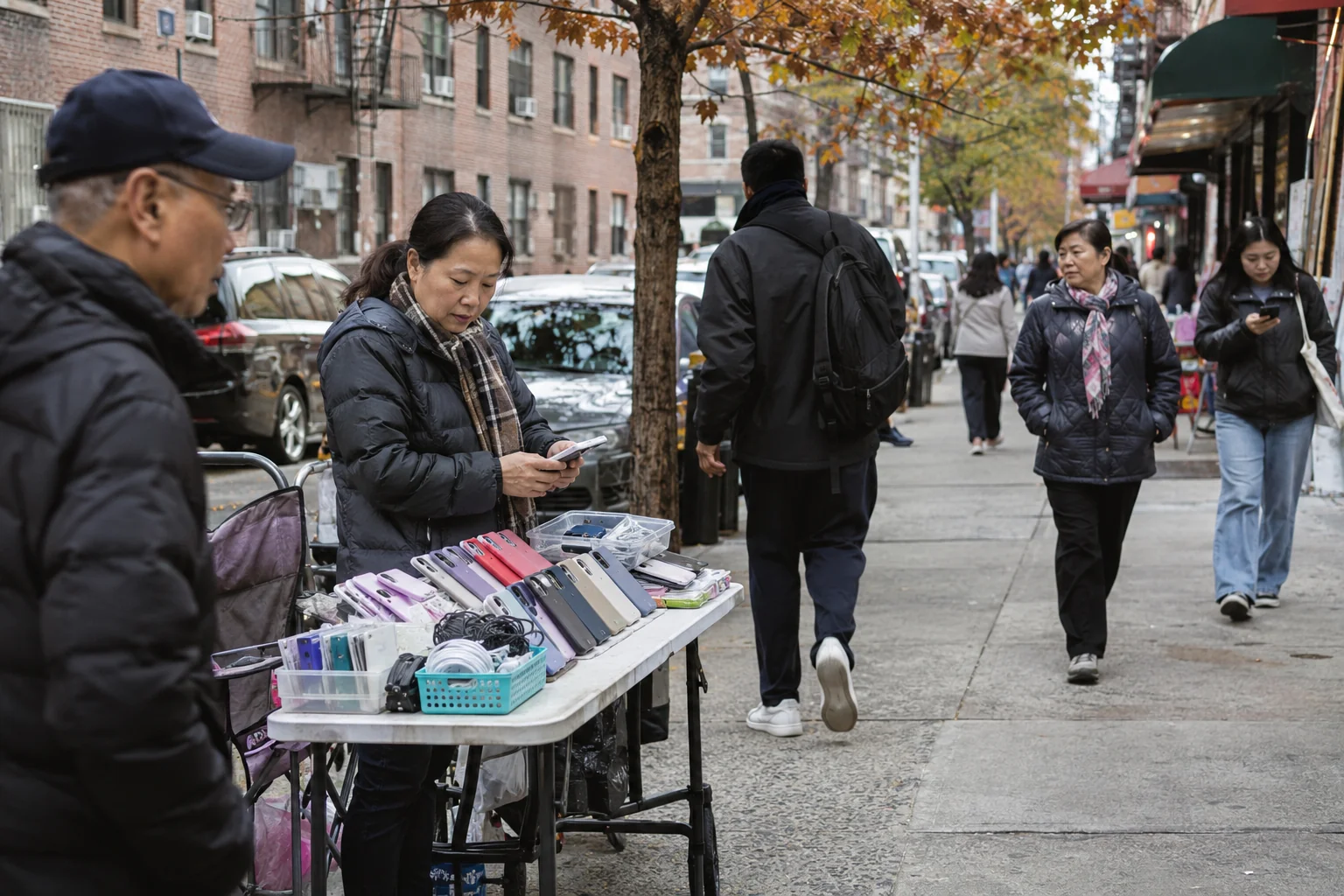
Imagine Mei is 46. She's been selling phone cases and small accessories from a stall near Main Street in Flushing for more than a year. She has no license and has been fined once.
(Mei is fictional, and the scenes below are hypothetical.)
In the past few days, she's seen two messages in her group chat. One says 「the city is making over 10,000 licenses available.」 The other is from someone promising her a license for a few hundred dollars.
What people are asking in the comments
This week there were Xiaohongshu posts about applications opening for General Vendor licenses. There weren't many comments, but the questions were practical. Can food vendors apply now, too? Do you submit one piece of evidence that you've vended, or do you need all of them? Some people wondered why someone who had vended without a license could move ahead in line.
These are questions from readers. Let's go through the official guidance from the NYC Department of Consumer and Worker Protection (DCWP), Department of Health and Mental Hygiene (DOHMH), and Department of Small Business Services (SBS), along with the law itself.
Where the 10,000-plus licenses came from
On December 18, 2025, the City Council passed a package of street vending reforms. Former Mayor Adams vetoed it on December 31. The City Council overrode the veto on January 29, 2026. The main measure was Local Law 54 of 2026 (text of the law).
For non-food vendors: Starting January 15, 2027, 10,500 additional General Vendor licenses will become available. Of those, 2,625 can be used citywide and 7,875 can be used only outside Manhattan.
For food vendors: Starting July 1, 2026, applications for 2,200 supervisory licenses will open each year for five consecutive years.
In September 2025, the Council also overrode the veto of another law, Local Law 122 of 2025. It provides that vending violations are no longer treated as criminal misdemeanors (legislative record). Fines and seizure of merchandise can still apply.
Non-food vendors can apply now
DCWP's street vending page says the 2026 General Vendor Waitlist application period runs from November 2 to December 16 at 5 p.m. The details below come from the application packet.
There are two waitlists. A white (Citywide) license allows vending in all five boroughs. A green (Non-Manhattan) license allows vending in the four boroughs outside Manhattan. You can use one form to apply for either waitlist or both. Each waitlist gets its own priority number.
What to submit: A completed application and a copy of a photo ID. The examples on the form include a state DMV driver's license or non-driver ID, a license or permit from a government agency, a passport, a green card, a city, state, or federal employee ID, and a municipal ID (IDNYC). The application doesn't list a fee.
How to submit it: To apply online, sign in to or create a DCWP account. To apply by mail, send it to DCWP Licensing Center, 42 Broadway, New York, NY 10004, with a postmark no later than December 16. In-person submission is available only in cases of special hardship, by appointment.
How the line works: People on the 2016 waitlist are first. The city already sent them offer letters this summer. New applicants go behind them. The application packet says new applicants will be assigned random priority numbers after the application period closes. Beginning in February 2027, priority numbers will be mailed to the address you provided. You can also look them up at nyc.gov/BusinessToolbox. Being on the waitlist doesn't give you a license.
Who gets priority: People who vended in New York City between January 29, 2025 and November 2, 2026. Examples of evidence on the form include dated photos of you vending, vending-related summonses or decisions, receipts for wholesale purchases, a state sales tax certificate or tax filings used for vending, and letters from elected officials, community leaders, or nonprofit organizations. The form says 「and/or」 and doesn't require all these items, but it doesn't say that any one item will always be enough. Keep what you can. Check that box only if you actually vended. The form says that if you check it and can't produce evidence when asked, DCWP can remove you from the waitlist, deny your application, or even revoke your license.
Who can't apply: Anyone with two or more convictions for possessing or selling stolen property or for trademark counterfeiting in the two years before applying.
What comes next: DCWP's FAQ says there's no age requirement to join the waitlist, but you must be at least 18 to apply for a license when you receive the offer letter. DCWP's published rules say the complete license application and fees are due within 90 days of the date the offer letter is sent. Miss the deadline and you'll be treated as having given up your chance, including your place in line. The license checklist lists a fee of $50 to $250, depending on when you apply. The licensing cycle is two years. Qualifying New York State veterans don't pay the fee. The checklist is available in Simplified and Traditional Chinese, but those versions are dated April 2025, before the new law. Use the English page for the numbers. The individual license application asks for a Social Security number or Individual Taxpayer Identification Number (ITIN). The form says it's used to check for unpaid child support and to update the city's database.
If you sell only newspapers, books and magazines, or artwork, you don't need a General Vendor license. You still need a state sales tax certificate. The exception doesn't apply if you sell other items alongside them.
I'd like to apply for the 2026 General Vendor Waitlist. Can I mail the application? What proof of my past vending should I keep?
That's how you can ask whether you can mail the application and which records to keep as proof of past vending.
Food vendors: This round goes to the existing waitlist first
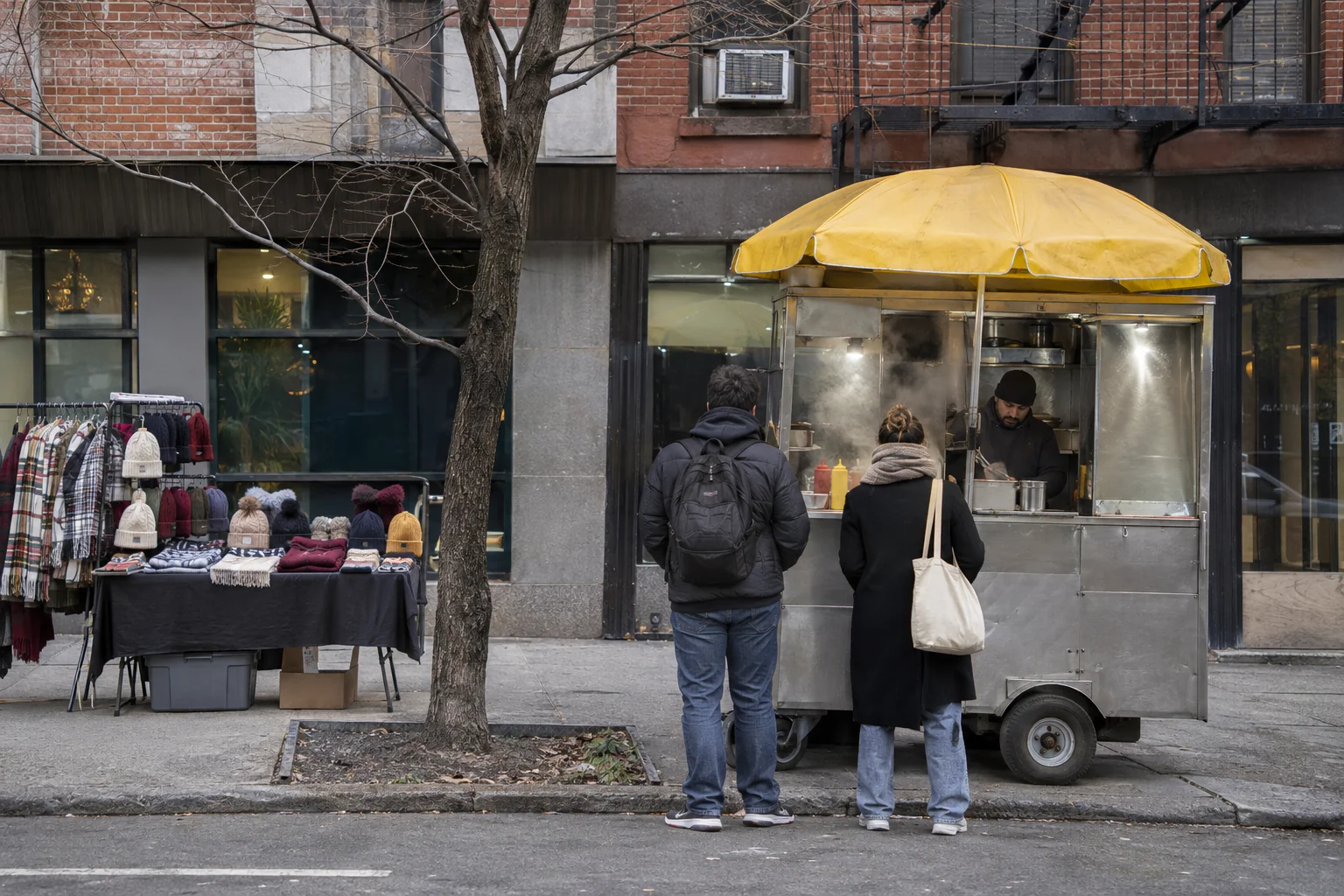
According to the Health Department's mobile food vending page, starting July 1, 2026, 2,200 additional supervisory licenses a year will be available to people on the waitlists created in 2022. The Health Department's supervisory license guide says 200 are for veterans and people with disabilities. If you don't have an individual mobile food vending license, you can sign up on that page to be notified when there's an opportunity.
The Health Department's supervisory license guide (titled 「监管执照」 in Simplified Chinese) says there's no fee when the license is first issued. Each two-year renewal costs $438. You'll have 90 days to apply once you're invited. The guide is available in Simplified Chinese.
It helps to distinguish two things. A license goes to a person, and a permit goes to a cart. Everyone who works on a food cart needs an individual Mobile Food Vending License. NYC Business says there's no waitlist for this license. It costs $50 for two years, requires a Social Security number or ITIN, and you must apply in person. The Health Department's page also says there is no cap on individual licenses. When you apply for the individual license, you must also register and pay for the Health Department's Food Protection Course. The course costs $53 and runs for 8 hours over two days. Apply and register in person at the city licensing center. Once you've completed the course and passed the final exam, your license should arrive in the mail about a week later. You can't start working until you've received it (Health Department course page). It is currently offered in English and Bangla, with no Chinese class.
The separate waitlist for veterans and people with disabilities closed on April 28 this year.
What you'll need no matter what you sell
A state sales tax certificate (Certificate of Authority). New York State's tax bulletin TB-ST-360 says to register at least 20 days before you start doing business. Selling without the certificate can result in a fine of up to $10,000. Display the certificate where it can be seen.
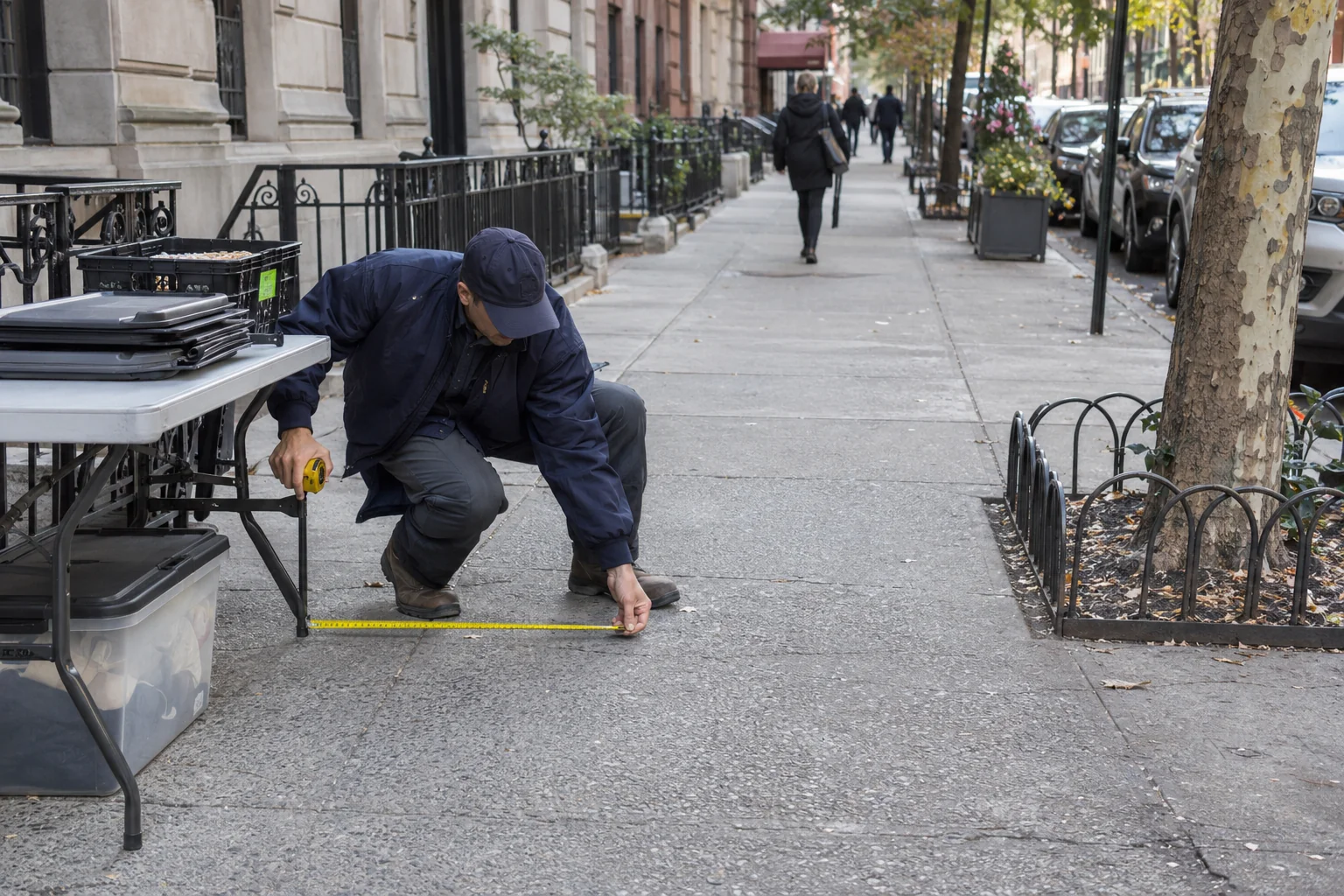
A place to vend. SBS's street vending page lists places where you can't set up. Non-food vendors must stay at least 10 feet from intersection crosswalks, subway entrances, and driveways. Stay at least 5 feet from bus shelters, newsstands, public phones or Wi-Fi kiosks, and accessible ramps, and at least 20 feet from building entrances and sidewalk cafés. The sidewalk must be at least 12 feet wide, and your stand must be within 18 inches of the curb. A stand can't exceed 8 feet in length, 3 feet in width, or 5 feet in height. Don't put goods directly on the ground. Mark the price of every item, either on the item or on a clearly visible sign next to it.
One particularly important restriction: There's an area of downtown Flushing where only blue and yellow specialized license holders can vend. It's bounded by Northern Boulevard to the north, Sanford Avenue to the south, College Point Boulevard to the west, and Union Street to the east. It includes the busiest stretch of Main Street. Blue and yellow specialized licenses go only to veterans with service-connected disabilities (license checklist). A white or green license alone doesn't let you sell there. Check the map on the page before you set up.
Fines. The Department of Sanitation's enforcement page says fines for unlicensed vending start at $250 for non-food vendors and $1,000 for food vendors. If your merchandise is seized, you can get it back after paying the summonses. After 48 hours there's a storage fee of $16.50 a day, and you have 90 days to pick it up.
Immigration status. The Mayor's Office of Immigrant Affairs' street vendor rights guide says that city staff won't ask about your immigration status when you apply for permits or when vending rules are enforced. You don't have to answer questions about your status.
Where to get free help
Small Business Services' Office of Street Vendor Services: Call 888-727-4692 (888-SBS-4NYC) and say 「Street Vendor Services.」 SBS's page says counseling is available in Mandarin, Cantonese, and Fuzhou dialect.
DCWP General Vendor Unit: GVUnit@dcwp.nyc.gov, or 212-487-4075 from 8 a.m. to 4 p.m. Monday through Friday.
For food vending, see the Health Department's mobile food vending page or call 311 to ask about the Mobile Food Vending License.
Free immigration legal hotline: 800-354-0365.
Two common “but what if” questions
「But someone says I can pay a few hundred dollars and get a guaranteed license?」
The application says priority numbers are assigned randomly after the application period ends. It doesn't matter when you apply, and the application doesn't list a fee. You can apply online or by mail yourself. If you need help with English, call SBS for help in Chinese. You don't need to pay someone to 「guarantee」 a license.
「But why should people who've vended without a license go first?」
DCWP's rule sets the priority. Among new applicants, people who vended in New York City between January 29, 2025 and November 2, 2026 go first. If you haven't vended, you can still apply, but you'll go behind that group. People from the 2016 waitlist go ahead of all new applicants. The lists will reopen on March 15, 2027, and new applicants will go in the order applications are received, without another lottery.
One last thing
For someone in Mei's situation, the next step is straightforward. Apply before December 16 and keep the receipts and photos from more than a year of vending, along with that summons.
You don't need to hire anyone to apply. The form doesn't list a fee, and city staff won't ask about your immigration status. The $50 to $250 license fee comes later, when you get an offer letter and apply for the actual license.
There's one more thing to check. If Mei's spot on Main Street is between Northern Boulevard and Sanford Avenue, even a white or green license won't let her set up there. She'll need to find another spot.
More than 10,000 sounds like a lot. Plenty of people have been waiting ten years, too.
Has anyone in your family vended in New York City? What was the hardest part? Share it in the comments.
Three steps before applying
- Decide what to sell and where you would sell it.
- Use the official checklist to prepare identification and check the deadline.
- Keep your application confirmation and track the address where you receive mail.
Date checked and sources
The pages below were checked on November 8, 2026. Mei and the scenes are hypothetical. The accounts in 「the comments」 come from public Xiaohongshu posts and reflect readers' experiences. This article is general information and is not legal advice. Some older official pages, such as the General Vendor waitlist information on 311 and SBS, haven't been updated. Use DCWP's street vendor page and 2026 application packet.
View official sources
NYC Department of Consumer and Worker Protection (DCWP): street vendors (https://www.nyc.gov/site/dca/businesses/street-vendors.page); 2026 waitlist application packet (https://www.nyc.gov/assets/dca/downloads/pdf/businesses/2026-General-Vendor-Waitlist-Application-Packet.pdf); FAQ (https://www.nyc.gov/site/dca/businesses/faq-general-vendor-licenses.page); license application checklist (https://www.nyc.gov/site/dca/businesses/license-checklist-general-vendor.page); Simplified Chinese checklist (https://www.nyc.gov/assets/dca/downloads/pdf/businesses/LicensingChecklist-GeneralVendor-SimplifiedChinese.pdf); Traditional Chinese checklist (https://www.nyc.gov/assets/dca/downloads/pdf/businesses/LicensingChecklist-GeneralVendor-TraditionalChinese.pdf); waitlist rule (https://rules.cityofnewyork.us/rule/general-vendor-license-waitlists/)
NYC Health Department: mobile food vendors (https://www.nyc.gov/site/doh/business/food-operators/mobile-and-temporary-food-vendors.page); supervisory license guide (https://www.nyc.gov/assets/doh/downloads/pdf/rii/supervisory-licenses-what-vendors-need-to-know.pdf); Simplified Chinese guide (https://www.nyc.gov/assets/doh/downloads/pdf/rii/supervisory-licenses-what-vendors-need-to-know-sc.pdf); Food Protection Course (https://www.nyc.gov/site/doh/business/health-academy/food-protection-for-mobile-vendors.page)
NYC Department of Small Business Services (SBS): street vending (https://nyc-business.nyc.gov/nycbusiness/business-services/initiatives/street-vending-in-nyc); individual Mobile Food Vending License (https://nyc-business.nyc.gov/nycbusiness/description/mobile-food-vending-license)
NYC Department of Sanitation: street vending enforcement (https://www.nyc.gov/site/dsny/what-we-do/cleaning/street-vending-enforcement.page)
NYC Mayor's Office of Immigrant Affairs: street vendor rights guide (https://www.nyc.gov/assets/immigrants/downloads/pdf/kyr-street-vendor.pdf)
Laws: text of Local Law 54 of 2026 (https://legistar.council.nyc.gov/View.ashx?M=F&ID=15326890&GUID=70F4B45E-BB41-4130-9AA3-C40B009502C5); legislative record of Local Law 122 of 2025 (https://legistar.council.nyc.gov/LegislationDetail.aspx?GUID=F1F80A80-6AF7-4F5C-9616-64DB0AEDF372&ID=6495041)
New York State Department of Taxation and Finance: TB-ST-360, sales tax registration (https://www.tax.ny.gov/pubs_and_bulls/tg_bulletins/st/how_to_register_for_nys_sales_tax.htm)
A useful next step?
JOIN THE CONVERSATIONReader notes
Checking sign-in…
Loading reader notes…